Tell pleasing lies, two decades out of date.
He lied about you: I should pat your hand
And sadly say I understood too late.
Long gone fears growl, howl, batter at the gate,
Summoned, undead, like bones from barren land;
Tell pleasing lies, two decades out of date.
No feelings now - let faith and judgment wait
For documents and witnesses. Demand,
O heart, a beast this meat will never sate.
Cut, gut me, heap me on your empty plate.
Win in the end, as you had always planned.
Tell pleasing lies, two decades out of date.
No wild hope, no, nor noble-minded trait
Sinks tales like yours neck-deep in desert sand.
O heart! A beast this meat will never sate.
And you, my mother, could have been so great.
Here's cursed forgiveness you won't understand.
Tell pleasing lies two decades out of date,
O heart - a beast this meat will never sate.
Showing posts with label anatomy of trust. Show all posts
Showing posts with label anatomy of trust. Show all posts

what it takes
So I haven't actually "spilled my guts" in this thing in awhile. It really is, and always has been, my online diary, though I did go through a phase when I wanted to gain wider readership for it. Far as I'm concerned now, that's not what a blog is for. It's where I stash that portion of my poetry and song lyrics which are not too private to keep hidden away in my notebooks at home, but a little too edgy, let's say, to post on Facebook.
Forget which movie this quote comes from, but I hear in my mind some British fellow saying "it's been a topsy fuckin weird year." That about sums it up. I still kinda have no idea where I am right now. Scratch that. I know exactly where I am--my neighborhood has become a part of my identity in a way no place ever has been before, my home in the sense that I've chosen to feel it so in addition to the fact that I reside here. But as for who I am and what I'm going to do with my life, that's still up in the air. Settling slowly like leaves in a light breeze.
Note to self: "settle groundward, slow" would be a great phrase to use in a poem.
A great sign of increased mental stability, though, is that I'm getting back both the urge and the ability to write. Not quite up to my four thousand word a day habit from former days. But Mom actually gave me a great metaphor for this yesterday. I was telling her how I'd been worried because lacking the fear motive which used to drive me towards writing, as a form of release from the internal pressure, had left me sort of adrift, hard pressed to find other sources of motivation. And she said, "If you've been driving a car 90 miles an hour in reverse and you want to go forward, first you have to come to a full and complete stop. Then you can start going forward--but at first you go slowly."
We also spoke about our family and the past in a general way. And I got to say something to her that I'd been meaning to say for awhile. Forgiveness means it's over. There were a lot of dark and scary times in our lives, but whatever happens in the future, the past will never return. Even if only because we're all different people now, tempered and matured through experience, and the things which were once unthinkably scary because there was no frame of reference for them will never be new again, never again be totally unexpected.
For a good thing to be familiar makes the joy in it deeper, richer and ever new again. For a bad thing to be familiar actually weakens its power. Even if you confront a terrible event from which there is no escape, if it's something known, something you understand, there's a place inside from which you can laugh at it. Not, of course, because it's any less terrible. Rather that even the terror of it can't eradicate you, can't take you away from yourself.
This, I think, is why I've always gone running towards the things that frighten me. To know, to have made the acquaintance, of anything in life, is to understand yourself in relation to it. And with this understanding comes the experiential boundary between self and threat source, the knowledge of just what it can and cannot take from you. Ultimately everything can be taken except the naked spark. Consciousness, soul, will--names sort of collapse into it--that part of ourselves with which we choose. But the sense in which, as I see it, we are made in God's image, is that a whole self can be built from that spark, just as in Genesis the whole universe is spawned from a single fiat, let there be. And there is is. And here I am.
Even now I have a problem with this, have trouble believing sometimes that I'm really here. I keep seeking out ways to strip myself down to it, as if to reassure myself that it's still there. Which can be as disturbing to anyone who's close to me as it is destructive to myself.
did it right
Feel like this song isn't finished. It rose in part from a dream I had, which was disturbing because it was (as I described it to a couple friends) my first-ever torture dream in which I was the perpetrator and not the victim.
The desire to wreak devastation on another person is what happens to the desire for interpersonal connection when one gives in to despair. When I believe, deep down, to the point where it's something I know and have tested many times and proven factual, that there is a depth and flavor of understanding which other people will not or cannot give me, there is the temptation to despair. If I give in to that temptation, then I desire to hurt others as I feel I have been hurt, to force a connection that can't or won't be given voluntarily.
I'm uncertain of the song in part because it doesn't go far enough. And it needs guitar chords. And some of the rhymes feel forced.
Also I'm wrestling with my ability to feel self-generated purpose to the degree that I'm asking myself, with some irritation, why I want to bother.
[did it right] 10/6
when the eyes roll back
when the breath croaks out
when the spine goes slack
then there ain't no doubt
when the bitch can't run
when the kid don't fight
that's how you know, that's how you know
that's how you know, that's how you know
that's how you know, that's how you know
you did it right
when the vomit's dried
when the knife grinds bone
all the way inside
then you're left alone
with the heart's last beat
though you're their last sight
at least you know, at least you know
at least you know, at least you know
at least you know, at least you know
you did it right
baby please don't speak
you'll dislodge the hose
I'm the one who's weak
I know where it goes
when you understand
you will smile so bright
cause I never let you go
never let you go, never never
never let you go
cause I hold your heart so tight
never let you go, never let you go, go
no, no
that's how I know you know
that's how you know I know
that's how you know I know you know
I did it
I did it right
eating out
This is a Shakespearean sonnet and also a pantoum. The sonnet contributes the meter and length, the pantoum the pattern of repeated lines in which the stanzas interweave with one another.
People who are used to keeping themselves aloof, in one way or another, over time can discover they've grown fond. And the fondness, even the comfort of growing accustomed to the comfort it brings, can be an uncertain thing that wisdom dictates one dance around. Like two people treading the spirals of a labyrinth, starting at opposite ends in opposite directions, their paths draw near together and then wind apart many times before they reach the center.
we two hands circle, meeting at the twelves,
spread from the rung round which the world revolves.
we lift the cup, pay up, indebt ourselves,
and even domesticity evolves.
spread from the rung round which the world revolves,
a wave of calm strokes down the ruffled spines.
and even domesticity evolves:
a slaughtered beast, poised succulent on tines.
a wave of calm strokes down the ruffled spines.
we sit up straight in hard-backed chairs and smile.
a slaughtered beast, poised succulent on tines,
rests warm within us, cradled there awhile.
we lift the cup, pay up; indebt ourselves.
we, two hands, circle, meeting at the twelves.
to all trains

Holy crap, this is the blues.
Within the first couple years I started writing poetry (and my songs started to not totally suck), I noticed that it's not possible to write about something until you're outside of it. You need the perspective of time and maturation to be able to create something that totally encapsulates what you've experienced. Which means, if you can write it, REALLY write it, then it's over. In the context of this here set of lyrics that is an incredibly good thing.
This exact sequence of events did not happen as such, because this process took place over the course of a little over two months. (Although the boots and hat, yes, are real, and look totally awesome on me, though not together.) Roundabout April and May sort of time period. It was after the shockwaves from what I called "hornet's nest time" (which is not possible to describe) had finally died down. During the time this song describes, the part of myself it took all that nasty to dig up out of where I'd locked it away was more or less firmly seated, and began growing to the point where I could functionally express it through my consciously accessible personality.
The preceding paragraph is weird enough, but I'll go one step further and say this. Intentionally investing a system of symbols with the emotional force of your entire personality is not a strategy I recommend for anyone, ever. The development, alteration and application of symbolic systems is an area of work in which I've invested a great big chunk of my life, and I still almost screwed it up completely. And even given how effective it all was, I'm embarrassed to think of how everything seemed to me at the time. Of course it's very useful to keep an eye out to see whether you've UNintentionally invested a few symbols with part of the force of your personality. Whether it's a few worrywart superstitions or a great big sprawling paranoid certainty, what's actually happened (if my own experience here is at all comparable) is that you've denied reality, denied existence, to a part of yourself. Which, as long as you live, will speak to you, will stand between you and the universe howling to be let back inside. And it feels terribly alien, inherently wrong, destructively desperate. Till you stop panicking and start listening.
the trash is talkin to me
what does it say
why you gotta love
what's gettin thrown away
crushed up cans of soda
brown orange peels
motorcycle tickets
cause somebody got wheels
got wheels, got wheels, got wheels
trudgin down the alley
late to punch in
a broken baby carriage
empty bottle of gin
I'm actin immature
and I'm addicted to news
I suck your every word
like it's a bottle of booze
of booze, of booze, of booze
when I let go
I get surprised
brand new black boots
in just my size
a rhinestone heart
a Stetson hat
"this is your song
listen to that"
the trash is talkin to me
speakin my fear
"you're absolutely worthless
you belong down here"
a bag of kitty litter
a toilet seat
"come cry here by the dumpster
wallow in your defeat
defeat, defeat, defeat"
keep on across the river
the Loop in the night
inside my skin I carry
everything that I fight
my heart is like a dry mouth
covered in tape
the truth I want to speak
it has no way to escape
escape, escape, escape
I peel it back
release the sound
I lift my eyes
up from the ground
above the gate
my love, my name
three little words read
TO ALL TRAINS
there's rails that run forever
I hope that you know
all God's children
have got someplace to go
whatever words you're usin
you listen, you learn
for everything you're losin
something good will return
return, return, return
love, weaponized
"Anything can be a weapon if you use it as one."
Don't know who first said that.
Thank God, though, even something that can be used as a weapon doesn't have to be.
The act of observation alters things;
Attention moves what can't be told or shown.
No wretched shame or agony can bring
More horror than the gaping deep unknown.
And so I love, for what we love, we know
More intimately than what we despise.
I will descend, and gaze up from below
What answers to no weapon but my eyes.
As stone wears smooth and spattered vomit dries,
As spasmed lungs draw down hot reek, wet chill,
I wrap my gaze, my lips, my hands, my thighs
Around what I cannot escape. I will
Remain, remember, love, accept, until
terror itself breaks, and I've had my fill.
the whether machine

all my machines are made of living flesh
and tears, and blood, and breath drawn deep and slow
my duty is to harvest, heap and thresh
but my joy is to cherish what I sow
here in the garden metal screams as leaves
fold out of armor, dripping, bright with dew
slow coiled roots roar, one wet red engine grieves
for though its tendrils bend to reach for you
each wire I cross short-circuits all the rest
each branch I stumble over splinters, sways
each touch I meant so gently rakes your chest
this bone-white bloom, this telephone who prays
is of no use if I do not connect
with those I’ve given trust, esteem, respect
a verrrry old dream log
Going through all my old boxes full of books and papers turns up lots of surprises. Ran across my old bachelor's thesis, on Philip K. Dick's "The Three Stigmata of Palmer Eldritch", for example. This, though, is a thing all its own, written from myself to myself and put to action. It was from a brief period where I wasn't writing dates on stuff so I only know, from the other content of that yellow legal pad, that it came about in midsummer of '03. A good (though kinda freaky!) piece of writing at least, and about where my head was at, at the time. Thank God I'm somewhere even nicer now. The dream itself is followed up by a couple of short analysis paragraphs which are from the same pages.
A beach of broken pebbles and cracked clams leads up to the House of Broken Things. The door is ajar. No board in its floor is unsplintered, no windowpane whole; even the rocking chair on the front porch is missing a leg. Out from under the porch darts a cat. Feral and lightning fast, its yellow eyes seem wise though they see the mouse in me. Tufts of fur missing to scars, tattered ears--is its fur grey?--it pads before me to the door of the house whose windows stand half-open like idiot mouths. The cat's tail twitches as it slides out from under my hand. I don't think I touched it. Brass knob, tarnished, old, turns with both hands and a thunk--I thought the door was ajar?--hinges creak. One comes loose, and I think the door is going to come off in my hand.
It doesn't.
Inside I think there is only one hallway, and there is, but my vision of it shifts and falsifies: I am left with an impression of winding crazed wood angles, locked, open, half-open doorways. A glance in one doorway reveals the unchanging, a gap-toothed piano with metal threads curled up under its wing, dolls with one eye that glares smirking. Another shows an empty bed, mattress stuck with its own rusted springs, cracked leather belts and a tongueless shoe that looks violent, a shadowy closet door. A few steps forward a girl's face peeks out, thin fingers wrap the wood just below the keyhole, cheeks smeared with tear-streaked dust, eyes achingly familiar. She darts back in, covers her retreat with a slam, but by now I know better than to follow. A draft whispers over my toes; I look up to see yellow eyes in the distance. The cat blinks once, twice, and I run to follow. Walls try to whisper their ancient cackles and though I cannot close my ears I don't listen.
The last doorway is locked but not closed. As I stammer, combing fingers through my hair, the cat wanders off, crooked tail slung low. The password comes back to me. Tunnelvision, I say to the dusty wood. It swings open and I hear my heart beat: this, the monster of my dreams. Blank whiteness. Viscous like the goop in a lava lamp, moving, its bulk fills the doorway and tentacles congeal, reach for me. My mouth chock full of a scream that keeps my teeth bound together. Don't encourage it, I tell myself. Out of the whiteness eyes roll down, lidless, and lips writhe into a mouth. Now only the tongue holds its ghost, the purples and greens of a clown face--not colors but hues bent wrong. I remember the dream that freed me from this face; I remember Atreyu between the sphinxes. I step through. So simple to say.
Looking forward, forward, up ahead a narrow chimney climbs up a cliffside, the path freckled with pointed stones, the angle of ascent maybe sixty degrees. I must keep my eyes on the ground so as not to slip or step on a sharp stone and injure my feet. I climb for what feels like hours, panting; soon my only thoughts are of the next step, the next handhold, for which I am distinctly grateful. Grey stone eases its way into russet, another geological age, and overhead I hear the rough voice of a crow. A fiber in my heart loosens. It is safe now to look back, I say almost out loud, and grabbing a handhold, turn to look over my shoulder. Down and down beneath the rockfalls, between the pitted forearms of the stern-faced hillside, a tiny ramshackle thing with a half-shingled roof gapes into the wind. On the stoop a white figure, spangled in what might have been frills but at this distance looks like dirt has its face turned unerringly towards me, foolish hat notwithstanding. I fancy I can see its mouth open at the touch of my eyes, and yet I'm deeply, madly grateful its running is running in place. I turn to face forward. There, the path spikes up and seems to end in the blue sky, the crow wheeling near beneath wisps of cloud. Clambering the last few steps, I fetch up somehow on my feet.
The plateau is a valley in the center of a circle of stones, great mountains that stand in the distance and remember. Behind me I cannot find the path I came by amid the boulders and sparse underbrush, and I decide that this is a good thing. To my right and left and behind me the mountains are gathering up their skirts, evergreens here and there, and on one hilltop a ways away I think a mountain goat springs from one crag to another. Ahead, there is no path, but a wide expanse of stone worn smooth by rain and wind and the passing of many feet. I step forward onto it and see, perhaps a hundred yards off, a circle of monoliths laid on monoliths like the great circle in England. I walk forward unhurried, feeling the wind through my fingers and the sun gently pressing the crown of my head.
There seated by the nearest of the twice eleven gates is a dragon, coiled around and over himself, silver-blue and blood-colored with eyes bright as a distant star. He winks at me, this old wyrm of the earth and sky--old to my eyes anyway. His rumbling voice is like drumbeats, joyous and solemn.
About time, he says.
I got a little hung up, I reply, dashing fingers through my hair. If I was too long in arriving he forgives me, and I am glad.
---
They are fools who think surrender is defeat.
A wise person knows that any endeavor can proceed either around an obstacle or through it, and can survive retreat if it is kept in order and those involved keep their goals firmly in mind. Of course the most glorious surrender is that which marks the transformation of an adversary into an ally--but this is a rare privilege and difficult to describe. I will say that apparent surrender, that is, misdirection, is a valuable tool in clever hands and can be used to thwart even a cunning opponent. But apparent surrender is not true surrender and is no fit replacement for it. This you should bear in mind in love as well as conflict, in friendship as in enmity. For one who consistently substitutes false surrender for true is no fit companion.
---
I began looking for a way, and as I went, the path sprang up around me.
diplomatic victory
Today is my one day off this week, and I chose to spend most of it playing Civilization III. I finally managed to finish a game, instead of quitting in the middle of the industrial era and starting over. Rather than play through to an inevitable defeat, I'll quit when I realize that a) I don't have enough cities to remain financially solvent and ahead in the culture race, or b) a nearby, militaristic civilization is about to conquer me and there is nothing I can do about it.
My first win was a diplomatic victory, which is achieved by being elected leader of the virtual United Nations. I'd traded with everyone, never been at war with anyone, and none of my spies had been detected in other civs' cities, so no one had reason to distrust me, and the vote was 3-1 in my favor. Yay winning.
The possibility of non-violent victory in Civ III appeals to me even more than the brain-stimulating complexity of the gameplay. Every other game with this kind of depth has one and only one path to victory: kill everybody who isn't on your team. I go along with it, since it's essential to the interface, but it's a thing to be tolerated rather than enjoyed. That's not how I approach anything in my life, and that's not a path of action I especially want to wallow in, even in an imaginary world.
That grizzled old axiom, "as above, so below" applies to the personality in a very direct way. Your deepest beliefs about the nature of reality, your operating assumptions, provide the perceptual framework through which you perceive your experiences and come to understand the world and your relation to it. The shape of your desires--the happiness for which you strive, the qualities of the world you wish to create around yourself--can only come together within the limits of the framework created by your operating assumptions. You can't strive to create a reality that contradicts your fundamental assumptions, anymore than Kratos in the game God of War can win by diplomacy. The interface simply doesn't support it.
I'm not really sure where I'm going with this. But I got to thinking on the subject of filters of perception after reading this article on the "quarter-life crisis" to which Gin And Tacos recently linked. (He also has a neat idea about how the US can help Haiti, and others, using awesome things we already have.)
Quarter-life crisis happens to many people my age, though the article focuses on those with educations and skills similar to mine who have also managed to hold on to reasonably decent jobs in the midst of the Second Great Depression (which is what this is!). Yet they are dissatisfied and hopeless, either because they lack the clearly defined ambitions which would give their lives direction, or they recognize that the courses of action they need to take in order to achieve their dreams are mutually exclusive. Have a family, or work hard to gain entry into a career which would enable you to support a family. Spend your income to maintain contact and enjoy leisure time with a network of friends, or spend it paying down your debt so that you can afford to maintain the same standard of living as those friends. I'm looking at some mutually contradictory paths as well, but still, I wouldn't characterize myself as going through a crisis.
To me, personal growth is all about watching the fruits of your assumptions play out in practical experience. "By their fruits you shall know them", though it was something Christ said about people, applies really, really well to ideas, and to the beliefs we form when ideas hit the cold waters of reality. At any given time in the process of constructing your personality, there's a portion of your identity based on new ideas and newly formed beliefs, struggling to find its best fit with the real-life circumstances those ideas were developed to describe. There's another portion composed of the beliefs which turned out to be valuable in the last set of life circumstances you encountered, which must re-form and stretch itself out to meet the demands of the new. And of course there's the core of your identity, the assumptions, passions and purposes which have stood the test of time and form your basic sense of self, the part of you which says "I" and is not contradicted.
All of these facets of your personality are organic things, living structures which grow and change as you employ them to form and develop relationships with the world around you and the people in it. As you express your personality through action, you change the world around you in accordance with what you believe, desire, and intend. You make the world of your experience a little more like the interior of yourself. The 'games' you play in life depend on the interface you've created in the structures of your personality. What you assume, that is, what you know and are certain is true, determines not only your paths to victory, but also your definition of what victory is.
A crisis of any kind describes a situation where you become conscious of the fact that the assumptions you have, your personality as it currently stands, the games you know how to play, can't turn what you have into what you want. It's actually worse, harder to resolve, when you don't know what you want. Not knowing what you want means that you have not found ways to express your desires and beliefs in reality to the extent that you can recognize the outward, tangible situations and qualities which match up with the living ideas which comprise your identity. You need to field-test your beliefs, in other words, to give shape to your desires. On the other hand, for a crisis in which you do know what you want but can't see any way to achieve or obtain it, I see exactly two solutions:
1. Change the games you know how to play.
2. Change your desires.
Right now I'm in the midst of option 1. There are personality parts I've brought online while working at the grocery store that I frankly doubted I'd ever be able to develop. I am part of a community here--and it doesn't frighten or unnerve me. I work hard, enjoy my work, am proud of doing it well, and have accepted the identity structures necessary to make those things happen--something I was never able to manage at any previous job.
Yes, there is a substantial opportunity cost involved in staying here. In my own bizarre way, I'm being compensated, though not in a currency that will (hopefully) ever be exchanged by banks or tracked in financial newspapers. It would of course be nice to have a job that paid me enough that I could afford to do debt service, save towards future goals, and go out and develop more complex relationships with my city and the people in it.
But unlike the folks in the quarter-life crisis article, I know what my priorities are and to some extent what I'm working to build out of the materials of my life. (I may not know what this contraption will do once it's put together, but I know darn well that tab A goes into slot B.) Personality construction comes first for me, resource accumulation, at most, third--because if the personality is shakily built and poorly designed, the resources will slip away in any case. As above, so below. And it's true that right now I have no idea whether I'll be able to have a family with Dave, record several albums, get some books of poetry published, write a few novels, and make a meaningful contribution to the theory of psychology in the course of my lifetime. Two victories out of five ambitions would be great.
However, I know (viz., it is among my primary operating assumptions) that while what I do now changes which victories I'll be able to pursue and how, I can't know the results of my current choices in advance. I weigh the opportunity costs which are visible to me now, and choose which advances, which experiences, which resources I'm going to spend this time in my life to get.
Every time in a person's life is like that. Every moment of our lives, we choose which ambitions we will value above all others, as Paris in the Greek myth had to choose which goddess was the prettiest one, to be blessed and cursed thereafter by her favor. We wrestle with the shape of our lives and the world we live in, as Jacob wrestled all night with the angel. In choosing to stay, to strive, to become, we echo Jacob's vow: "I will not let you go until you bless me."
roseanne vs. the vma's
I'm just an ordinary average guy
my friends are all boring
and so am I
we're just ordinary average guys
~ Joe Walsh
I have a problem with envy.
Every year when awards season comes around, I gather my pettiness around me like skirts and flounce away from the TV. Or at least away from the channels where one may watch the Emmys, the VMAs, and various other musical award shows. I don't want to see droves of people who are, in my heart's reckoning, not quite as good at songwriting as myself, be fêted and fawned over and asked to give speeches--or even have the cameras pan over them while they watch with sour expressions as rivals give speeches.
The real reason they are there, of course, has more than anything else to do with merchandising. That is, the amount of money their CDs, mp3s, concert tickets and associated gewgaws are able to siphon into the pockets of their corporate sponsors. But supposedly--nominally--in theory--they are being honored for having created wonderful music. As the creation of wonderful music (though I lack the means to distribute it at the moment) is one of the central load-bearing pylons of my identity, this is maddening. I feel like the dog who must sit and watch while I, the foolish human, slowly devour a delicious-smelling steak which the dog is one hundred percent certain is rightfully his. Hence, I do not watch these shows, because I tend to act like an ass and sarcastically insult all the performers, even the ones I like, and detract from everyone else's enjoyment.
As I said, a problem. A problem for which a practical solution still evades me. All I can do on that front is bide my time, keep an alert eye and a grasping hand ready for any resources I can use for the purpose, and continue to get better at writing and playing songs. So that when I do find an opportunity to do more than nothing about it, the quality of music I can actually produce will be as high as freaking possible.
I used to have another, more serious problem with elitism--or, to use the wider-reaching Biblical term for it, pride. I touched on it briefly in my last post.
It came directly out of my extreme social awkwardness and low self-esteem; identity-wise, that sort of pride is a last-resort defense against loneliness. It says, I am not excluded from these social relationships because I am an unworthy ally, but rather because I am so special and different that it is important for me to hold out for something better. Which contains a couple of major untruths right on the face of it. First, the falsehood that certain kinds of people or relationships are somehow better or worse than others. After assuming the first falsehood, the second falsehood states that being unfit to have "lesser" kinds of relationships somehow gives you extra points or makes you more fit to have "better" kinds. Take the two wrong ideas together, and you get a burst of ego-soothing pride every time some incident takes place which ought to have made you feel ashamed. Like all fake "good feelings" that come from lies, though, the emotional energy for it had to get stolen out of another part of your personality. In this case, it comes from robbing yourself of the ability to like, respect and trust others.
Pernicious lies like the above are the sort which ruin otherwise decent personalities and make the people who exist through them impossible to like. All the self-loathing, acting foolish et cetera that I eat raw to try and shake them off are a very small price to pay, considering the risk. And the risk is not totally gone. I still have a somewhat shaky hold on self-respect, still have trouble holding on to friends once I've made them (though at least I can now make friends pretty easily because I like everyone and it shows), still catch myself mentally turning my nose up at things which I know are good and valuable and not to be scorned. It's like Jefferson said: The price of freedom is eternal vigilance. Personality construction isn't architecture; it's flow mechanics. It's being able to maintain a standing wave with just enough curl that you can surf in it.
So yesterday evening Dave was channel-surfing and we ended up watching an episode of Roseanne. It was one of the big end-of-the-series ones where all the relationships have more or less stabilized and everyone's together twisting together loose strands of plot. So people were talking about the big stuff, relationships and love and the future, way more than in your typical sitcom episode.
I have no idea why, but when I was a lonely, ulcerous little kid, the Roseanne show stood for failure in my mind. I'd never watched it, just assumed that it was about people who'd given up striving for Greatness and Fame and a Chance to Earn a Place in History, and chosen to settle for being (ick!) an ordinary, average family. One of those nasty-assumptions-based-on-several-falsehoods that I didn't think about consciously, and wouldn't have recognized as such until I'd taken the trouble to drain out all the tributary falsehoods. That life isn't worth living unless at some point you attain Greatness and Fame. (And presumably Even More Ulcers.) That being part of a large, loving, occasionally squabbling family that still has each other's backs when it counts is somehow a bad thing, or an unimportant one. To name just a couple.
As I sat there and watched the show, saw all the plot threads come together as the fictional family reaffirmed their love and support for one another, I felt the same old gut-twist of envy that I normally expect from watching the VMAs. These fictional characters, for whom I used to feel casual, unexamined contempt, had something I desperately wanted. Not only the acceptance (howsoever grudging sometimes) and the togetherness (howsoever irritating sometimes), but the stability and means to enjoy and focus on those things. It's just a show about an ordinary, average family who has the freedom to sit around and live life and work out their relationships with each other, and the reasonable expectation that they can keep doing so. I want that, more intensely than I want a record deal, even. And at the moment, I'm about equally likely to be able to get either one.
Luckily I have a lot of practice appreciating the irony of moments like this. A way of life for which I once felt ill-thought-through contempt turns out to be one of my highest ambitions. A seemingly unattainable one, too, at least in the immediate term. Pass the salt and carve the crow, it's a typical dinner at my place.
Tomorrow Paula's going to be coming over to pick Dave up. Him staying here is not something I can afford with what I'm making now, and none of his job opportunities in the area panned out. I have no idea what's going to happen next. And this time that doesn't feel like a good thing.
authenticity
The entrance to the place was clogged with sweating courtiers--not the sleek top-level ones but the dented, scarred, slightly too old and slightly too ugly ones who actually got everything done.
~ Neal Stephenson, Quicksilver, p.168
"I just lost my best friend on Dead Man's Curve!"
"What's Dead Man's Curve?"
"It's an incredibly dangerous curve in the fake highway we built."
"Why would you build an incredibly dangerous curve in a FAKE highway?"
"Authenticity!"
~ Upright Citizens' Brigade, the episode with the space dolphins
Authenticity is dangerous, elusive--necessary. Pundits cross verbal swords over what the "real America" is or isn't, hipsters chase an ever-receding horizon of cool, philosophers and theologians argue over the original intent of ancient texts, governments attempt to demonstrate the connections between their mechanisms of power and the will of the people they rule and, supposedly, represent. And very little of this, when I boil it down to its syrupy essence, has much to do with my life in practical terms.
I spent probably more than half my life in an attempt to win free of a deep-seated, irrational self-loathing. And just as, in this man's army, the reward for a job well done is another job, the success of that project cascaded into another project: self-respect.
Looking into how people put our personalities together has led me to observe some things about norms--the expectations and standards of behavior we use to judge the worth, the coolness, the desirability of various actions and behaviors. We also use norms to create and, unconsciously at least, rank the categories into which various types of persons may fall. A norm is, structurally, a collection of memes which we have invested with belief.
I've got some of the classic ivory-tower intellectual norms about blue-collar jobs. You could call it prejudice, naivete, or even something nicer if your norms lean in the same direction. Namely, deep in the bottom of my brain, I feel that people who work with their hands and the strength of their backs are in some weird way nobler and more connected to reality than people who sit at desks and crunch numbers or wrangle legalese.
Since most of my jobs have been the sitting-at-desks kind, I've experienced an interesting tension between pride in my work and shame that it's not "honest" labor. Now, however, I'm in a place where I don't just feel like an authentic, hardworking American laborer, I actually am one. I work (when I'm lucky) eight hours a day, on my feet, slicing meats and cheeses. I make salads, help customers find items, even make sandwiches or pizzas on occasion, and at the end of the night I take deli slicers apart and clean them, mop floors, and turn out the lights when I leave.
And I'm friggin' loving it. I actually do feel more connected to reality, and even if it's only an illusion created by my preconceptions, it's a useful illusion and I cultivate it. This teeny tiny job in this one grocery store is where the rubber meets the road. The whole corporate hierarchy of the company which owns "my" store, all the people who have desk jobs crunching numbers and wrangling legalese, exist so that I can have a side of beef or turkey or ham to slice up, tag, bag, hand to a customer and say, "Would you like some cheese with that?" Call me crazy, but I've been here almost three months now and it's still exhilarating.
The coolest part about it is really the human aspect. There's a camaraderie among people who work together with their hands that just doesn't exist in an office. We spend a shift together, or at least within eye contact of one another, performing the same mind-numbing and back-straining tasks, over and over, getting hassled by the same hilarious (in retrospect) customers, staring at the backs of the same item tags and watching to see when our trays and dishes need to be refilled. And when there's a lull in business, when it's time to mop up at the end of the day, when we're outside catching a cancer stick on break, we connect like real human beings. We swap war stories about crazy customers, talk about our kids/parents/significant others/roommates, and just generally bask in mutually earned respect.
Far from having my old norms dispelled by a rude shock of horrible reality, I find them confirmed and solidified. It matters that I can spend a shift pushing pizzas and squirming my whole torso in under the counter to scoop up precise weights of potato salads and still walk out the door smiling. It makes a difference in somebody's day that I gave them their turkey sliced to the thickness they wanted, got them a sample, and still found the energy to joke about the weather. If I want to be a bodhisattva when I grow up (even if that is just a collection of ideals I've assembled in my brain! or like a saint, but with more arms--both good!), then this is a step I absolutely could not have afforded to skip. This is freaking important.
Sure, I spend a lot of time worrying about money. That, too, is part of being a real authentic blue-collar American. At $8.20 an hour (per union contract for new hires--did I mention I'm in a union now? how cool is that?), the difference between 27 and 30 hours a week is the difference between not quite being able to pay my rent and being able to pay it and also buy bus fare and maybe some eggs, bread and beer. My manager is cool about it--she schedules me for the first seven hours of an eight-hour shift, so that if, at the end of the night, I find there's enough work to keep me there a bit longer, I can call in to the person-in-charge and get me an extra half-hour or so for the night. Gives me a chance to juice the clock from 27 hours up to 30 or so, in other words. Me being an awesome worker and high-energy customer service guru is the difference between getting that consideration and getting scheduled for the union-contract-minimum 16 hours per week--which would most definitely not be enough to pay for my rent, bus fare and food.
I work at a nexus in the maelstrom of commercial exchange, but subsist on a very narrow margin between the income I can produce and what I must consume in order to continue eating and living indoors. Every day is a balancing act. Sure, I could get the employee-discounted coffee for $0.83--but do I have that much in my bank account? Will I need it later for rent or bus fare? Or do I actually need to get it, to get a cash-back amount of less than $20 (the minimum ATM withdrawal) so that I can recharge my bus card in order to be able to get to work tomorrow?
It's kind of weird. I worry about this stuff every day, I run the numbers over and over in my head to reach the same sums, and then I take a step back into the philosophical, metagaming sphere which is my native realm. And I ask myself things like, "In what do you actually believe?" or "What gives you strength and keeps you going?" or "Whence comes your help?"
People.
Relationships.
Love.
Magic.
I am reformatting my personal definitions of all those things with every step I take, with every slice I push through with the strength of my arms, with every cent I spend. Authenticity, as I conceive it, is a thing you earn by living in spite of difficulty, through effort, by meeting challenges for which failure is not an option. It is the triumph of the spark in the ashes of the phoenix, the extra twenty minutes you put on the clock, the quarter you find in the gutter that makes bus fare home out of not quite enough. It is the difference between independent life and living under a bridge hoping for a handful of someone else's change. It is so very little, and in the final analysis, everything.
pride and disgust
Apartment hunting developments in brief, for those who are interested:
The place we were looking at before is now a non-option. Leasing agent told me verbally that we'd start on a month-to-month basis and would be out if we fell a month behind; I assumed co-signing would be on that basis and told Mom and Amber this. However when Mom called the leasing agent, he told her it would be a minimum six-month lease, for payment of which both principals and co-signers would still be responsible in the event of eviction. I am annoyed with the agent for this, but hey, what can be done?
So I'll be looking at another place tomorrow and yet another on Friday, and we'll see what happens.
The rest of this post is about things inside my brain. As that is the purpose of this blog: to spill my guts for your amusement and possible informeditude.
For this post, there's a chart I want to scan, and maybe later I'll figure out how and scan it in here. It's a handwritten copy I made from a chart on page 78 of Peter Carroll's Liber Null. (I later lent the book to a friend, so I'm glad I had made the copy.) The chart divides up the many shades of emotional experiences into a wheel, where each emotion is placed across from its opposite--loathing opposite greed, anger opposite joy and so forth. Sure, it's Carroll's personal interpretation of how emotional experiences can be divided up, but as a concept it can still be a useful tool.
One perspective on it is that one can use the chart to understand the tensions within experience. In physics, every action produces an equal and opposite reaction. In personality construction, every emotion produces an equal and opposite emotion. To be angered by one experience is to create within oneself the potential to find joy in another.
Another side of it is that in a sense, each emotion contains its opposite. When we experience greed and loathing, the actual relationship each emotion creates is very similar: only the direction is inverted. Loathing pushes us away from the object and greed draws us toward it, but in both cases, we are bound to it. We develop a powerful relationship with the object of our emotion, a relationship which influences our perceptions, our choices, even our values. In math, the "absolute values" of "plus 5" and "minus 5" represent the same distance from zero--just in different directions. In a similar way the "absolute values" of positive and negative emotions can represent the same distance away from "no relationship at all".
So, once upon a time, I was in high school, and I was plagued by constant, intense feelings of self-disgust. A gesture, a word, a stray thought out of place--and how many stray thoughts go out of place in a minute? an hour?--and a wave of moral and emotional nausea so intense it was almost physical would rise up in me. I disgusted myself to the point where it got in the way of everything except breathing. (Unless I breathed too loud or sniffled. That, too, disgusted me.) Thus, I decided the most sensible thing I could do would be to eliminate the emotion of disgust from my personality.
Those of you who have been reading me or listening to me blather for a long time already know this story. It's one of my standard referents, and is still something I'm pretty proud of, because that was my first step in the direction of attacking my emotional issues head-on. At the time it was a really smart move, because this one emotion was totally out of control and throwing everything else inside me out of whack. (Er, out of alignment. Whatever.) Unless I put the work in to develop ways to manage this emotion and keep it within its proper, useful context, letting it back into my personality would have been unwise.
However, when I removed one negative emotion from the spectrum of my experiences, I also removed its opposite, positive emotion. I didn't know what it was, exactly--until it came back! Recently I have gotten to the point where I have a kind of pride born of self-respect. Of having proved to myself, to my own satisfaction, that I'm competent to meet various challenges. A whole bunch of real-life experiences went into this, some of which I've blogged about, some I haven't. Some are still ongoing. (which will hopefully always be the case! one should never cease to grow!)
Three days this week, I'm on loan from my usual grocery store to another store in the chain. This other store is about to close; it has very few customers and very little staff and is generally older and dingier than my store. For the first time I'm alone behind the deli counter and responsible for it. I'm doing pretty well, and I'm proud of myself for it, in no small part because this is a comparatively blue-collar sort of job, "real, honest work" as I see it, for which my previous experience hasn't much prepared me.
And I noticed that I was starting to feel disgust. Simple, honest, physical disgust. At the intense amount of work I had to do to keep this deli counter sanitary and free of flies, at the process of skewering raw chickens for tomorrow's roasting, at the way certain items got dried out and nasty during the day. About halfway through my shift I realized that I was feeling disgust--and immediately I understood what this meant.
The self-confidence and pride I've got now, which are based on having set and successfully met various challenges for myself, these things are the opposite of the self-disgust which used to be so crippling for me. Pride based on practical knowledge is the opposite of disgust based on irrational terror. Worthy / unworthy is the spectrum of experience I'm talking about. Right now the scale is very small--but nonetheless I've come back around full circle. So there's a whole wavelength I'd cut out of my emotional spectrum which has now been restored to limited functionality! Hooray for functionality!
:D
We're in the process of getting married! And moving!
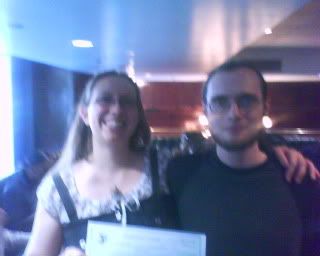
That's us, yesterday, at Ronny's Original Chicago Steakhouse. Steaks and Buds for both of us were only $20, because Ronny's was having a sale. The piece of paper I'm holding in the photo is a marriage license, which cost twice that. (Dave found a fellow restaurant patron who was willing to get our picture using Dave's phone, because it seemed to me that you-all would be slightly mollified if we at least had a picture.) So we have between now and Nov. 14th to get it signed by a judge or cleric and sent in to the Cook County officials. Perhaps we will keep the actual date a secret for awhile after the fact--but we are most certainly keeping it a secret before. This is going to be the most non-secret elopement it's possible to have, but it's still going to be an elopement. Because that's what we want to do. So there. At some point after the actual documents are official, when we can afford it and have agreed on a design, we're probably going to find us a good tattoo parlor and get our wedding rings. :D

Immediately after food, we went north to see an apartment which I can actually afford on the money I'm making working at the deli. And as Dave pointed out, if he found a job in the neighborhood, we would be making significantly more than would be necessary to survive. We could, in other words, start doing cool stuff like debt service and savings. We'd still be living right next to a train line--just a different one. The one I take to get to work. Much, much closer to work. In a neighborhood that's actually slightly nicer than the one in which we currently reside. So depending on how fast we can get an appointment to see the leasing agent (and whether our execrable and/or nonexistent credit is adequate) we could, in theory, start moving our stuff into it while it's still September, and start paying rent Oct 1.
Now, if I were you, and if I read this from the other side of the interscreen, I can tell you what I'd be thinking right about now.
 (And by "you" I mean "our friend or loved one, who quite likely knows us in real life and would have been invited to our large, public ritual for the acknowledgement of heterosexual life-partnerment, such as the one shown in the above photo I copied without permission from the website of a photographer apparently named Ian Haring, if in fact we were having one, which we are not, at least not at the traditional time in the process.")
If I were "you", I'd be thinking:
"Huzzah, good for them, and about freaking time!"
"Those sneaky jerks have forgone a large public ritual, thereby denying me and everyone else who knows them the opportunity for the vast exchange of social-structure and relationship information which the organization and performance of such a ritual exists, in large part, to expedite! How very rude, even if it is monetarily practical at the moment!"
See, this is why elopement is both frowned upon and attractive, depending on one's feelings about large, complex social relationships among large numbers of people. When many different relationships, some very intense, between a whole lot of people at the same time are all going to be altered by a single event, it makes good sense to mark that event with a public ritual. Just in terms of emotional and mental economy. That way everyone who has a stake in the event can symbolically communicate to everyone else involved what the event means to them, how their relationships with various other involved parties are going to change, and (just for garnish!) how they feel about the fact that it is happening. Furthermore, because these changing social realities are acknowledged publicly, simultaneously and symbolically, everyone has a much better chance of remembering who now means what to whom afterwards. The form of the ritual itself acts as a mnemonic device: common ceremonial elements serve as shorthand to describe relationships even to persons not within the social group but familiar with the culture. "Oh, do you know them well?" "Why yes, I [did X] at their wedding."
Also, too, it gives people an opportunity to express their love and support* in a highly condensed and reasonably approachable way.
So, if you feel you absolutely must do something to express your love and support**, by all means, please come and help us pack, help us move, come over and find stuff we're not going to be able to take with us and take it back to your dwelling with you***. Or you can, y'know, wait for us to give in to the inevitable and start planning a post-matrimonial party of some kind. Haven't talked it over with Dave yet, but I'm thinking Firstiversary Party. Has a nice sound to it, and is sufficiently far away****. ;)
Love and pez be unto all of you.
I for one am exceedingly***** happy.
* or their hatred and opposition
** or hatred and opposition
*** or call our prospective landlord and tell him nasty things about us, sneak into our current apartment at night to unpack our boxen, and leave behind large, badly damaged pieces of furniture
**** also, it now occurs to me, announcing a Firstiversary Party would require revealing the date of the actual marriage, which would be fun
***** but not, I think, excessively
she slices, she dices...she is finally blue-collar
On my last day off, which was Thursday, I went up to my old college to try and get the last bits of paperwork done which were keeping me from my degree. Mom stepped in like a champion, got leave from her work to go visit their plant up in the area so she could give me a ride there, and even paid the last couple little fees I had on my account at college, though she could ill afford to do so. I am greatly in her debt!
Tomorrow, however, is my second off day in this week, so I can afford to spend a little time blogging. Ah, the comfort of the written word. Even generating 3000 words in five hours did not sate me. I must write more, for the peace of my mind. So I write.
These days I am reminded of Idle Theory, a concept delineated by a fellow named Chris Davis as one of the factors in determining evolutionary fitness. I wish I could find his original page, which had some nice diagrams and such, but I will explain briefly. Idleness is the amount of time and energy which an organism has left over after it has satisfied the basic requirements of immediate survival--food, sleep, etc. Think of it as the profit margin of effort. Organisms with a very small amount of idleness are vulnerable to environmental changes. A small change in the requirements for immediate survival can mean the difference between life and death for something living on the edge. In contrast, living things with high levels of idleness can afford to spend their extra time and effort seeking out interesting mates, scouting out new territories, playing internet games, et cetera. Societies, which are themselves organisms in a sense, also change their behaviors based on idleness. Societies with low idleness tend to emphasize virtues such as hard work, thrift and rule-following--because if those virtues are not practiced by most individuals most of the time, that society will burn through its "profit margin" of available effort and collapse.
For me, personally, this is the lowest level of idleness I've ever attempted on an ongoing basis. Oh, I had some worse period at Aigre Doux (now defunct, Clarissa tells me, so I suppose I can use its name!), but those were periodic, not continuous. Let me show you some deli-counter-worker math:
8 hours per day at work
3 hours per day in transit (1.5hr train + walk time)
8 hours per day sleeping
leaves
6 hours per workday for other activity.
See, at the office-type jobs I've had in the past, internet access was part of worktime, to a limited extent. I could play my KoL turns, make the occasional blog post (in bits and pieces, by keeping the window open behind other work), and read random stuff to keep my imagination sizzling. I sat on my butt and typed and talked on the phone and spoke a lot of doublespeak.
Now my day is spent on my feet. I lift meats and cheeses out of the counter, on and off the slicers, work the slicers with hitherto-unused arm, shoulder and back muscles. I often lean my entire torso into the cold salad case to carefully scoop out, say, potato salad, without smearing tuna salad or curry on my apron or elbows in the process. It is like a combination of contortionism, spelunking, constructing a stone wall out of smallish rocks, and playing an endless game of tug-of-war with a gaggle of children. And I haven't even been on the café side and learned to make sandwiches or fry chicken in super-hot grease yet!
The thing is, though--I am happy. I feel like the guy at the end of Office Space. I'm doing something constructive and real. So what if my back feels like it has a knife stuck in it between the hours of seven and nine pm most nights? So what if the customers ask me to thin-shave a full pound of our messiest, juiciest meat at 8:45pm when I'm supposed to be disassembling and cleaning the slicers and sweeping the floor, when the auto-slicer is done for the night and I must do it by hand? I can hack that. That is no frickin problem. I sing while I slice, I banter with customers, I try to convince the nice ladies from the café side of the counter to teach me Bosnian. I've only been here a couple weeks, but I can weigh by the quarter-pound with either hand now and I know half the item codes by heart. And apparently all my coworkers like me, because I like them and think they're cool, and I'm sunny and polite and work like a fiend and sing.
For some reason, my day-to-day sense of identity is tied up in my work to a fairly large extent. Maybe it's because so much of how I remain socialized is a conscious process; the personas I use in daily life are assembled "by hand" rather than by instinct. And much of my consciousness is swept up in the self-check routines by which I create and assure my continued sanity, functionality. So there's not a whole lot of tolerance in me for identity concepts not directly supported by incoming data.
Oh, there is a residue. Life events and decisions leave a mark, little permanent records which say "you rose to X challenge to Y extent. you reacted to A crisis with B level of competence." Each little possible area of life I am able to approach with what I deem to be honor and nobility, by that increment is my heart eased and my childhood certainty weakened--the certainty that I am useless and without value. Not sure where it came from. Perhaps that knowledge is down in my spaghetti memory somewhere, safe to recall only when its poison is nullified.
Nobility is being equally comfortable, confident, competent, equally able to belong, in all places and all circumstances. Heinlein has a quote about it, a quote which I don't recall verbatim that ends "specialization is for insects." Honor is integrity in action: that you behave at all times and in all ways so that the world you wish to experience is the world which your actions make more possible.
In previous jobs, then, I have demonstrated to myself that I can be white-collar, that I can be an egghead amongst eggheads. That I can type numbers into a screen all day and night and still have the wherewithal to go to altavista's babelfish and crib enough Spanish to tell the dishwasher that his money was direct-deposited to his bank account and he should have it within three business days. That I can research the doings of a city which I have never visited, through news clippings and random statistical journals, well enough that my supervisor can go to that city's government and ask the right pointed questions about how they handle their finances. That I can shout down an aged building owner, whose concept of how business is done was cemented in the fifties, in a vain attempt convince him to pay for renovations required by fire safety regulations passed into law in the nineties. All these things I know about myself.
But now, now if I can keep this job for enough months to satisfy myself, I will have proved to myself that I can put in eight hours of real work, like a real person. Oh, the mad mad lengths to which we go for self-respect. It is worth it.
Besides, my unemployment was about to run out. There is some irony, as this back-aching job pays only $8.20 an hour, and thus nets me per week exactly the same amount as I used to get from unemployment, for doing nothing.
Still. I am happier, because even in a time of extremely low idleness, I am happier doing something than nothing.
the distributive middle: part 2
(Even though this is more of a conversation, I like to start things off with a quote. The Rambling Taoist has been doing a verse-by-verse ramble through the Tao Te Ching, and this is one of the ones I really like.)
Stop being holy, forget being prudent,
it'll be a hundred times better for everyone.
Stop being altruistic, forget being righteous,
people will remember what family feeling is.
Stop planning, forget making profit,
there won't be any thieves and robbers.
But even these three rules
needn't be followed; what works reliably
is to know the raw silk,
hold the uncut wood.
Need little,
want less.
Forget the rules.
Be untroubled.
~ Ursula LeGuin rendition
(The below is as follows: Amber's quotes of my previous post in italics, Amber's comments in bold and blue, my responses in plain.)
"But an experience of this caliber in which the Great Big Thing of Refulgent Wonder and Unadulterated Joy came up to me in some way and said, "You should call me Jesus. That's my name, has been all along. Thought you should know." That would convince me."
If this is what you really, really want I will pray for it to happen. I have the joy and hope of salvation and want you to know that joy. It is strange to me the tormented twisty anguish that you seem to be feeling but how can I help. I am glad you are seeking answers.
I thank you as always for your support and good wishes!
However, I wish to nitpickily say that the above is not “what [I] really want.” It is what I would accept. I would not even then be terribly pleased about it, but I would be convinced.
What I've been trying to do in these posts is explain the tormented twisty anguish that is so strange to you. It’s what I was feeling, for those years when you and I did not talk to one another about what was happening inside us because we each had other concerns and other stuff to talk about. I am glad you had "the joy and hope of salvation" to sustain you during that time. The promise of salvation and of heaven after death was rarely joy and hope to me. If you’re up for a long, long bunny trail, I had a somewhat lengthy comment on this Geds post where I discuss it in some detail.
(Though I now, on reflection, want to point out there is a fourth option to the three I mentioned in that comment. A person can combine the mind-manufactured imaginary friend with a dimly-glimpsed recognition of the big, good thing and attempt conscientiously to bring the former gradually into alignment with the latter. It can be done, and I hope it is what the majority of nice people are working on deep in the bottom of themselves.)
And you are helping. You are helping me sort out my negative feelings about Christianity. When you can look and listen to my story that I spent too long being too ashamed and afraid to share, without treating me like a leper or rejecting me, that is helping. So even if it's not what you would most prefer, you are still doing something good for me!
Now, if only I could get a dozen Christians who are at least as willing to listen compassionately as you are, and a dozen atheists who could actually refrain from snarking at the Christians or calling them names long enough to really listen to their perspective. Then this crazy blog would be halfway to my goal for it!
My new goal, that is. It already served and outlived its original goal, which was to both provide me with a secure outlet for my crazy ramblings and enable me to use said ramblings as reference material in my continuing quest for a semblance of sanity. The tipping point was when I determined that ‘the sneakiest one knows where the rat faucet is.’ And no, I am NOT going to translate that, this tangent is long enough already.
"Things that are unlikely to convince me, or any other person whose mind is not yet made up, include things the Jesus described in the stories did not do, to the best of my recollection. He did not threaten people with hell, even by reminding them obliquely that hell exists."
Okay, I will have to stop sending you greeting cards that say things like Happy Birthday, I love you, oh by the way Hell exists just so ya know, Laterz!" Ok seriously from my limited Bible scholarship I actually agree with you on the whole sheol vs. lake of burning fire thing. (No, I repeat, no relationship to the movie Joe vs. the Volcano). I believe you understand that people are trying to be kind. For example if you saw people walking past you into certain death (insert humerously improbably form of certain death here) even though it was their life and their choice you might point out 'that way danger, easy to avoid, go this way instead'.
Teehee. No, you are not the person I was chiding with this statement, nor really this whole paragraph. I do get that when you bring it up, and that is rarely, it’s because you believe that this is true. And you don’t want to see your sister either a) suffer eternal torment and pain for rejecting the advances of the One True Love, or b) suffer eternal loneliness and regret for rejecting the advances of the One True Love.
My central issues aren’t as existential as Ryk’s—he finds himself unable to reconcile the concept of the perfectly loving ultimate being with a being who would consign any sapient entity to limitless torture while it still has the will and self-awareness to recognize its mistake. Ending the selection process at death seems kind of arbitrary for a being who invented the complex relationship between life and death, and has shown itself, according to the books, able to conquer both. But I’ve wrapped my mind the idea of hell and/or the grave to the extent possible given my extremely limited actual information versus the riotous host of claimed information. While it is a curious thing, it doesn’t pose a structural problem for me in terms of being able to expend effort to overcome my disbelief—certebus parebus, all other things being equal.
I appreciate your care, but I must point out that we still disagree about the location of the danger. In the place where you say there is danger, I have found refuge from harm. In the place where I remember there being danger, you say there is safety. If a random stranger came up to me on the street and earnestly told me about the dangers of hell and the joys of salvation, I’d feel kind of like Charlie the Unicorn in episode 3, after they’d already taken his kidney in episode one. (It’s a weird video, if you haven’t seen it, but definitely SFW.) I believe you that your God is not, in fact, after my kidney or whatever, but that is mainly because a) I trust you and am willing to take your word for it, and b) I am seriously doubtful that I have any metaphorical “kidneys” left to steal. This is therefore a matter which requires close scrutiny on my part.
Just please try not to overanalyze and think things. Analysis is good but your last couple have posts have seemed almost frenzied. Yes, eternal salvation is worth being excited over but remember. God is Love, you've read about that. Remember that fruit thing. Okay so it was talking about people being known by their fruit and a good tree brings for good fruit etc. I think God is like that too, the love of God does not bring frenzy and stress. (okay Mom,
Ah, overanalyzing and overthinking. (I think I may safely assume you still wish me to think things—just not to overthink them!) Frenzied, eh? *shakes fist playfully* I’ll show ya frenzied!
Seriously, though, I am glad we had a chance to discuss this one on the phone. The tone of frenzy, as I mentioned then, may come from the fact that this part of my personal story is something I hadn’t “gone public” with, especially within the family, while it was happening. The main motives for the kinda-secrecy were fears--fear of being misunderstood, rejected, or oh-so-well-meaningly emotionally pressured into what I then perceived as a lifetime commitment to despair, self-loathing, shame, and worthlessness.
And “by their fruits you shall know them”, like most of the things said by the Jesus of the Gospels, is really very good advice even if one is not religious! My favorite thing to do is actually to take the logical inverse of statements like these; in my experience they actually have equal predictive power, and the different phrasing helps my brain not gloss over the advice as an oft-heard cliche.
“If you’re not looking at the results of their actions, you don’t really know them.”
“If it doesn’t set you free, it isn’t the truth.”
“If you wouldn’t want someone else to do it to you, don’t do it.”
I like the thing is says somewhere in the new testament about "God does not give us a spirit of fear but of power and love and a strong mind." I know you have a strong mind Viz and I pray for you to also have a spirit of power and love. Oh gosh, this is why I'm glad we read scriptures as kids, now I'm reminded of the perfect love casts out fear verse. Okay, I'm rambling back to your post.
Again, thank you for your good wishes.
I’m working towards a spirit of love; a spirit of power is something I’m decidedly not working towards in any specific way. As my guy Gareth Knight says, if you truly desire a thing, work to obtain its causal antecedent (that which causes it to exist). Love is antecedent to true power, so that seems to be the right track.
As to not having previously acquired those beneficial spiritual attributes through communion with God, who knows? Perhaps I was asking in the wrong way, or as I feared at the time, without sufficient earnestness. Perhaps the only times I actually experienced God back in the day were those “mountaintop experiences”, which with a few notable exceptions were mostly those big group sessions where the group’s emotions drove back the chaos in my own mind. Maybe all that baptism in water and baptism in the spirit and asking Jesus into my heart as my personal savior just didn’t take. "Sorry, none for you." If so, alleged God and I would have a few things to discuss if communications ever were established. Pointedly.
"Jesus did not sigh at and turn away and whisper over those who were being led astray. Instead he took people who had lost all hope, and helped them to see themselves through his eyes--as redeemable, as worthy, as wonderful.
Which is one of many reasons, many reasons I've gone into here and elsewhere, and some I've yet to name, that the idea of returning to Christianity in truth fills me with trepidation."
Golly, he just sounds so trepeditaion inspiring and annoying. Who is he to go around loving people and stuff.
"The person in those stories is a damn hard act to follow." So you want to follow that act? I am pleased to hear that. Perhaps you can encourage me to do likewise. That whole feed the hungry, clothe the naked, visit the imprisioned stuff he instructed his followers to do is stuff I believe in but can be hard to remember when there is shiny cable and internet to be distracted by.
Heheh. Yeah, loving people is pretty audacious. It’s kind of like with listening to people. At one end of the spectrum, some soak it all up without seeming to get any benefit from it, while at the other end, some seem totally unwilling to receive it even when you desperately want to give it to them. Small wonder the guy in the stories got killed. If humans don’t eat one alive for trying to help them, they take mortal offense that one dared to offer them help.
It IS a scary example to contemplate following, even in small ways. Like you say, good and fun things in life are distracting. And the God you’ve described to me doesn’t seem like to sort who would want his followers to be eaten alive or killed. (Unless they decided they wanted to make a really, really important point by doing so.) Most of the preachers I thought were not full of hooey over the years advocated making the most of the places you already were. Loving people more than expected, helping people more than strictly necessary, listening to people whom no one else wanted to be around.
So hey, maybe if I were a follower of this neat imaginary friend, it would be easier to become that kind of person faster and more efficiently. In the meantime, I have a pretty happy life, and I perversely kind of enjoy doing anything the long way around. You get to know where you are better that way.
Especially (no offense meant, sweetie!) when I have grave suspicions that the shortcut involves chloroform and kidney thieves.
the distributive middle
We have pitched our tent in the excluded middle and abdicated any responsibility to check things out.
~Fred Clark, in his recent post, "Reporting the controversy"
Under the leaden wings of night
I see this brood of melancholy
half-gods and half-men,
pitiable because they are neither
the one nor the other.
I grow afraid and turn away
from the bottomless pit of perfect
knowledge.
~Max Ehrmann, from "The Abyss of Perfect Knowledge"
Surely the cure for fear was not more fear.
~Lois Bujold, in The Warrior's Apprentice
Dad used to joke that if you were bad in a past life you had to live in New York, if you'd been good you got to live in Los Angeles, and you ended up in Chicago like us if they didn't know what to do with you. Weatherwise, I can kind of see the joke, except for how southern California catches fire every fall. But no country, no really big assemblage of people, I think, would be complete without somewhere that fills each of those metaphorical roles. New York, a place where cutthroat deals are brokered, heads are rolled, and heaps of competitors exist to be clawed out of the way. Los Angeles, a center of creativity, culture, fashion, and every kind of insanity under the sun, all inextricably mixed together so that what ought to be terrifying becomes, with just a little bit of distance, charming. Chicago, a place where the details are ironed out, the language clarified, the contracts drawn up, and the red tape wrapped up and stowed away in good order. A city of clerks, lawyers, accountants, go-betweens. That is the place where I feel most at home; those are the fallow fields in which I yearn to (metaphorically) dirty my hands. Not the undistributed, but the distributive middle. The place from which things hurry to their proper destinations. It's a role I feel proud to aim at, and if it started as reflex and self-defense, it became something else. The kid who was terrified of bats and muggers achieved his potential for good when he became Batman. I don't have the resources, athleticism or awesome secret cave necessary to become Batman. But perhaps there's something else awesome, another role yet to be named, for me to try.
And even though pity, like condescension, is a thing I am confident in despising due to intimate, omnidirectional familiarity, being pitied by peers who had no personal agenda with me had one very positive result. People, as a rule, do not pity those whose warps and flaws they consider irreparable. To be pitied disinterestedly, to be pitied with exasperation rather than dismissal, implied there was something I could do about it.
It's hard to describe what I've been doing with myself without sounding, to my own ears, like a complete bore or a complete terminology snob. I have a really, really good reason for being a terminology snob, though. It goes something like this list of, er, guidelines. Formulated in numbered style just now. It's an amalgalm of proverbs cadged from books, advice given by people, and observations carefully named long after I'd learned their right use. If you recognize a reference, good for you! I agree with and applaud your taste.
1. Anything is a weapon if you are determined to use it as one.
2. A weapon you don't know how to wield is a weapon in the hands of your opponent.
3. Whoever is not against you, is for you.
4. An ally is one who can both "shoot" (wield a given weapon) and "aim at your enemy" (understands your necessities well enough to know who else is your ally).
5. The mind is the only weapon; all other "weapons" are merely tools.
6. To name a thing is to define your relationship to it. Once you have outwardly expressed your understanding of a thing, that is how you will perceive it until you openly express a change in your view.
7. You pay most attention to that which you have named.
8. You store memories of those things to which you pay attention.
9. You approach new experiences based on what you remember.
10. The degree to which, and the ways in which, you adapt yourself to new experiences both reveals and shapes your identity. (You are what you do. Choose again, and change. Oh, and also Excellence, then, is not an act, but a habit.)
As an adolescent, my mind, my emotions, my memories, were things I did not trust. And thus felt I had to assume, till I could confidently name them otherwise, that everything inside me was a weapon in the hands of an opponent, visible or invisible. Furthermore I had no way to determine which persons, visible or invisible, were in fact my allies as opposed to my opponents, until I was able to restore the integrity of my organs of perception. To put a metaphor on it, you need to be reasonably sure you've been looking through a telescope and not a kaleidoscope before you step out of your cave to make the long, grueling journey across the desert.
Every embarrassing, depressing or otherwise broken thing I found in my psyche was in this sense a positive sign. One less piece of the machinery of my self that was liable to rise up and bite me when my back was turned. It's still frustrating and depressing, though, to discover one thing after another in myself that's smashed or clogged or so hopelessly slagged as to require a complete overhaul. Hence the most important guideline, best rendered in all caps:
IF YOU FEEL STUPID, YOU JUST GOT SMARTER.
(With its lesser-known corollary: if you never feel stupid, you are probably being very, very stupid indeed. Although, I hope you're all about to object, it is decidedly unhelpful if you always feel stupid.)
So. Onward and inward, to things tangled enough I'm not sure how to name them except in metaphor and generalization. Not quite right to say that cities are like people--they are a whole different order of organism, made of people, by people, but with their own strange kind of life. But people are surely like cities, like our ideas of cities at least, more so than is comfortable to admit sometimes. Many things go on inside us that are so very difficult to etch in the memory, prison in words, mark down on the map. The map which never quite matches the territory.
Religiously, I started out firmly planted on one side of the fence: belief. Then I flung myself over it (like a Californian!) into disbelief, in hopes that the grass on that side of the fence was a little less on fire. Much later I tried climbing back up onto the fence, seeking a better view. Only to find that the fence itself was little better than a polite fiction, a string drawn taut across the grass. The relationships between the names people use and the things to which they refer with those names are complex and not easy to unravel. That there are realities behind the names, that the things in which the thoughtful and sincere have invested their belief, have truths behind them, seems very likely. We're dealing here with matters where objective proof is off the table. So it's incredibly important to me to understand both my own subjective experiences and the subjective experiences of others as best I can. These are the experiences which shape our beliefs regarding our purpose in life, the attitude we should take about our place in the universe, the possibilities for hope. Our beliefs in this area feed directly into our operating assumptions about our identities, and those identity assumptions are the engine which permits the personality to take shape and to function at all. And the only primary-source knowledge that exists on the subject is inside living people. All else is hearsay.
Unfortunately (for me and my insatiable curiosity), the people who've invested belief most totally are also the ones most likely to fall into "A therefore A therefore A" descriptions when you try to get them to explain how and why they came to do so. Not that they're unwilling to share their experiences--very much the opposite! Rather, the difficulty is that, having chosen a reference frame, you have to move into it with them in order to make any sense of how they put it together. And once you demonstrate the ability to move within their symbol set to their satisfaction, they quite naturally assume that since you're inside their home paradigm you must already agree with them, so there's no point belaboring the obvious by explaining things which you clearly must already know and are simply too stubborn to admit.
On the other hand, the people most willing to pour out their innermost thoughts into any handy reference framework they are offered tend to be those who haven't thought through their own experiences or tested them to the point where they have any useful idea what they're going to do with them. People who may have heard of various symbol systems or structures of imbedded belief, but who through lack of understanding, lack of confidence, or lack of motivation, have not managed to put any of them to very much use. (You know that saying, "There are two kinds of people in the world: those who say there are two kinds of people of the world, and those who don't"? If we do that with the people-types I'm describing here, I'd say I belong in with the people described in this paragraph.) They are like the data-tape spewed out by the little robot-demon in the Cyberiad. Every word of it, once properly understood, is a true witness of the person's worldview, and much of it would be extremely useful in the proper context. But since it has never been honed on the whetstone of any single perspective, the likelihood of the right knowledge cozying up with the right information (to therefore beget wisdom) can seem depressingly small.
In trying to understand the experience of belief, then, and not merely its function, my ongoing investigation faces some handicaps. The worst information sources are the best, the best the worst, in a sense. The thing, namely myself, with which I can take that information and combine it with knowledge (with metaphorically sexy results!) is in hopefully-diminishing ways as suspicious as the information itself. It has taken the better part of ten years to painstakingly reach that place where my judgment, such as it is, on those matters where I deem myself competent to give names, is something I am willing to trust.
I want to distinguish between belief, lack of belief, and disbelief.
Belief and disbelief are both positive, definite stances; they give the names, true and untrue, to the things they name. Once a personality's resources--faith, hope, love, and the mother of these, attention--have been committed to a positive stance, personality structures can be built on it. And a lot of those personality structures involve really important things. Such as the ability to have certain kinds of shared experiences with others whose selves are built on functionally identical beliefs.
Lack of belief indicates an attitude of information-gathering. Personality resources have not yet been invested in a name, a definite category of perception, a stable relationship. (Those three things are causally and functionally linked, if not identical.) The idea is that when observation and experience in favor of either belief or disbelief reach a critical mass, the personality tumbles over into the appropriate stance without a conscious application of will. If a conscious effort of will is necessary to push the personality into a positive stance, this means the individual is not actually convinced. They have conceded to the acceptance of the name of truth or falsehood without having, themselves, acquired the wisdom to rightly apply that name. They have, to translate it into the system by which I understand these things, placed the weapon of their own identities in the hands of someone else. Of whoever gave them that name, which they accepted without truly believing.
All this to say that yes, I absolutely have the ability to force myself back into my former belief. Or into a simulacrum of it, cobbled together from the ruins of that belief and the assertions and descriptions of others. But this is something I will not do. It is too important to force, to do half-heartedly. A half-hearted conversion is no conversion at all. It is, and please forgive the intimate metaphor, the spiritual equivalent of faking an orgasm. Something you only do when you have lost all hope of having a real one.
If it is in fact good and right and just for me to be a bride of Christ, I will not be the sort of bride who lays down on the marriage bed gritting her teeth and muttering "let's get this over with." So don't ask it of me. It would be repugnant and a disservice to both parties.
On to the question that a believing Christian must, in good conscience, always ask, even in cases where tact and wise caution restrain them from asking it out loud. What would it take to convince me? At this time, I have a very short answer.
An unambiguous religious experience. If the name of Savior-and-Lord is a name with something real and solid behind it, if it is something so infinite that I will never have to wisdom to bestow it, then I want it from the horse's mouth. To smash a metaphor.
I've had, as I mentioned in some previous posts, several experiences in my life to which I have given the name religious or spiritual experiences. (If not without some trepidation. If I were lazier or it wasn't important to me, it would have been equally possible to write these off as projections or imaginings simply because they are subjective. But I've been over and over them and I'm still of the opinion that there is a noticeable distinction between these and the ones I imagined. Though, obviously, I have yet to name the cause.) Times when I brushed up against--nouns, you might say. Person, place, thing, idea, or some weird amalgam of all four. Some I could definitively name opponents. A few, by their actions and the stamp of their presence, can be called allies. Some number involved those which were more difficult to qualify--rather like trying to decide if a rock or a tree is your ally or not. But an experience of this caliber in which the Great Big Thing of Refulgent Wonder and Unadulterated Joy came up to me in some way and said, "You should call me Jesus. That's my name, has been all along. Thought you should know." That would convince me.
Things that are unlikely to convince me, or any other person whose mind is not yet made up, include things the Jesus described in the stories did not do, to the best of my recollection. He did not threaten people with hell, even by reminding them obliquely that hell exists. In fact, from what I know of the Bible, unbelievers are described as descending into Sheol, the grave, or to outer darkness where there is weeping and gnashing of teeth. The lake of fire is said to be for the devil and his angels, witches (described somewhere in Samuel, I think, as those who compel the souls of the dead to do things against their will) and Sodomites (and the defining wickedness of Sodom, according to Judges, was a predilection for gang rape without preference as to the victim's gender). Jesus did get pretty harsh with those who abused their religious authority to gain social power over others, but he tended to criticize them for their present evil deeds and only rarely went on to describe the future results of those deeds. He did not condemn people for breaking religious laws--even broke a few himself, when he judged the cause was just--but instead demonstrated his love and acceptance and urged them to do better. (If I can do it, you can do it!) He did not withdraw or shrink away in moral repugnance from people whose lives were steeped in distasteful acts or humiliating failures, but befriended them, ate at their houses, treated them as though they already were the people he saw dimly within them. Jesus did not sigh at and turn away and whisper over those who were being led astray. Instead he took people who had lost all hope, and helped them to see themselves through his eyes--as redeemable, as worthy, as wonderful.
Which is one of many reasons, many reasons I've gone into here and elsewhere, and some I've yet to name, that the idea of returning to Christianity in truth fills me with trepidation. The person in those stories is a damn hard act to follow.
A response to Pleiotropy re: homeschooling
This post started out as a comment on Pleiotropy's recent blogpost, The homeschooling trap. However, Blogger apparently doesn't like comments that run longer than 4,096 characters (I think that was the number), so I'm posting it here. Head over to Pleiotropy and read his post if you want some background!
His post is primarily about homeschooling, but one of the main underlying issues is teaching kids creation vs. evolution. I don't feel, myself, that that really ought to be the main issue (information content and quality are two different matters, as I'll get into later in the post) but it's the one where debaters on all sides have the strongest opinions.
I invite comments and discussion! But because this is an issue where people have very strong feelings, and because I (hope I still) have readers who practice what they preach on both of them, there might actually be a discussion. We are all here on the blogosphere because we are intelligent people who a) know how to read and write, and b) like doing both of those things for the fun of them. It is my hope that any discussion that happens here will be fun for everyone involved! If I have unfairly characterized or insulted anybody, please let me know, as this was not my intent.
***
For me the biggest struggle moving from homeschool to school away from home wasn't even the socialization factor. It was the routine. Since my mom was teaching just me, my older sister and my younger sister, that meant that whatever I was learning, I was the only one learning it. And I would study it as long as I needed to do so. Which meant in my case whipping through the reading, vocabulary and history parts and dragging painfully through the math and science parts.
The thing is, my mom did a damn good job of teaching me. Leaving aside for the moment the God-shaped orientation of the curriculum itself, she is a smart lady who taught me how to read and write and spell and do math. And my dad was a smart man who, though he wasn't our primary, everyday educator, encouraged all his daughters to think critically and ask questions and to love the encyclopedia (in the pre-Google era) and the dictionary. My parents read to us. They talked about stuff with us and liked it when we asked questions. Us getting a good education was really important to them.
So for me, for the most part, homeschooling meant I got lots of one-on-one, personal tutoring from my mom. And got used to being able to learn as quickly as I wanted if a subject came easily to me, or stay on a unit or do extra work if I had trouble "getting it". The structured pace of school away from home, having to sit still in a desk instead of doing my homework in my room or on the back porch, not being able to provide 50% of the conversation for every lesson, was even more excruciating than trying to socialize with my peers.
I went to Sunday School. I played with kids on my block. Our homeschooling families group went on field trips together. It isn't like I was totally isolated in a nuclear family bubble with zero outside contact. The transition wasn't from non-socialization to full socialization. It was from one kind of daily routine to another kind of daily routine.
So what if I had to re-learn all that history and science without the pro-Christian bias when I went to high school (or, if you prefer, re-learn it all with the anti-Christian bias)? The material itself was never the problem for me, only the social consequences. I said evolution wasn't true once in freshman biology, because it was what everyone my whole life had always told me. (Except Dad, who secretly believed in evolution, but had stayed pretty vague on the subject when I was younger.) And the result was comparable than the time I said "Who's Kurt Cobain?" Except this time the teacher was exasperated with me, and not just my fellow students.
Cultural indoctrination occurs on many simultaneous levels. Expected common knowledge is only the most superficial of these. Behaviors, values, emotional display levels, taboos, and subtle group-hierarchy signaling methods are much more difficult to learn. All cultures indoctrinate: this is how culture functions. Members of a group learn to share common habits, norms, and social signals so that they may interact with one another with a maximum of understanding and a minimum of stress. This is why transitioning between two different cultures causes "culture shock"--a myrad of things one learned to take for granted must be re-learned and placed in a new context.
Going from a private, Christian school to a public, secular high school is a massive dose of culture shock. Going from being homeschooled to attending a school away from home is a massive disruption of habit and procedure. I do think that having to deal with both of these stressors at once would be terrifying for any young person. If I have a problem with homeschooling, that's it. However, going to high school is inherently terrifying, and I think that many young people probably could deal with the extra changes, given the right emotional support etc. I think it would be very possible for a parent or parents to help cushion the shock for their kids, provided they are in a position to do so.
But I think it is oversimplifying the matter to urge parents not to homeschool because it indoctrinates their children into a culture and belief set in which the parents themselves are heavily invested. THAT IS WHY THEY DO IT. They believe that indoctrination as such is not wrong, so long as it is done in service of what they earnestly believe to be the truth. And as I mentioned earlier, when one is a member of a culture, so a certain extent indoctrination must occur! You believe (and, having deconverted and given the evidence another look, I also believe) that evolution is the way things happened. They don't. They believe evolution is a dangerous lie that makes people more likely to be amoral and unhappy. They don't want their kids to be amoral and unhappy. They are willing to do whatever it takes to protect them from this fate.
And it is not, primarily, access to the information itself that poses a problem, as they see it. It is the attitude towards that information, learned in a cultural context. When a person has an attitude, an opinion, a belief, about an important subject, the attitude they possess is a primary signifier of the group to which they belong.
Saying that homeschoolers are likely to be more ignorant presumes that the parents doing the homeschooling are generally unfit to teach. Some aren't fit to teach--but many are, especially the types of basic information that gradeschoolers need to learn. "Ignorant" in the sense of not having been given access to science texts with evolution in them, I will grant you. In the very narrow sense of not having been provided with otherwise generally available information on a particular subject.
But this ignorance is easy enough to overcome later in life so long as the person is able to read, learn, hear, and speak. Triply so if they have any love of learning. Human beings, however they are raised, have an insatiable curiosity, especially when it comes to forbidden things. And those of us raised inside the evangelical bubble all know perfectly well that vast troves of information were being kept from us "for our own good." To a young person this is fascinating, frustrating and in short, a dare.
(This post is getting the Tuesdays tag because, like other Tuesdays posts, it deals with issues of social structure. The irony of the fact that today is Friday is not lost on me!)
Subscribe to:
Posts (Atom)


